
Note · 5 Pages
Daniell Cell & Galvanic Cell
- Daniell cell
- Construction
- Observations on operation
- Reaction and electron flow
- Key points
- Electrode signs – comparison with electrolytic cell
- Reversible and irreversible cells
- Galvanic Cells
- Working of Galvanic Cells
- Setup of a Galvanic Cell
- Understanding the Galvanic Cell with an Example (Zn-Cu)
- Some important terms
- Solved Example
- Summary
Daniell cell
A Daniell cell is a type of galvanic (voltaic) cell that converts chemical energy into electrical energy by harnessing a spontaneous redox reaction between zinc and copper ions. It consists of two half-cells connected by an external wire and a salt bridge.
Construction
One half-cell contains a zinc metal electrode immersed in an aqueous solution of zinc sulphate, ZnSO4. The other half-cell contains a copper metal electrode immersed in an aqueous solution of copper sulphate, CuSO4. The two half-cells are connected electrically by a conducting wire and ionically by a salt bridge which permits ion flow while preventing direct mixing of the two solutions.
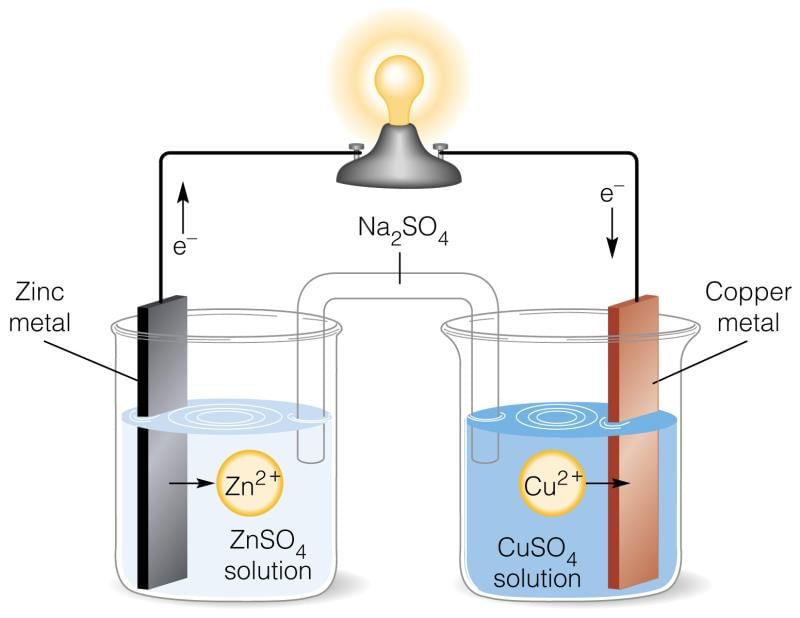 Daniell cell
Observations on operation
- When the two electrodes are joined by a wire, an electric current flows through the external circuit.
- The zinc electrode gradually loses mass as Zn atoms are oxidised to Zn2+ ions and enter the solution.
- The copper electrode gains mass as Cu2+ ions in solution gain electrons and deposit as metallic copper on the electrode.
- The concentration of ZnSO4 increases while the concentration of CuSO4 decreases.
- Both solution compartments remain electrically neutral overall because the salt bridge maintains ionic balance.
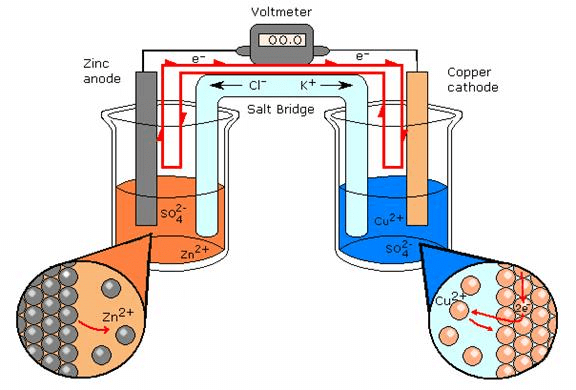
Reaction and electron flow
Electrons released by zinc travel through the external circuit from the zinc electrode to the copper electrode. Oxidation occurs at the zinc electrode and reduction at the copper electrode. The overall cell reaction is the sum of the two half-reactions:
Thus the zinc electrode is the anode (site of oxidation) and the copper electrode is the cathode (site of reduction). Electrons flow from anode to cathode through the external circuit; positive charge is carried internally by ions through the salt bridge to maintain neutrality.
Key points
- A voltaic or galvanic cell consists of two half-cells; each half-cell has an electrode and an electrolyte and supports a half-reaction (oxidation or reduction).
- The electrode where oxidation occurs is called the anode; the electrode where reduction occurs is called the cathode.
- Electrons flow from anode to cathode through the external circuit; conventional current flows from cathode to anode externally.
- Chemical energy of the spontaneous redox reaction is converted into electrical energy delivered as an electromotive force (emf).
Electrode signs – comparison with electrolytic cell


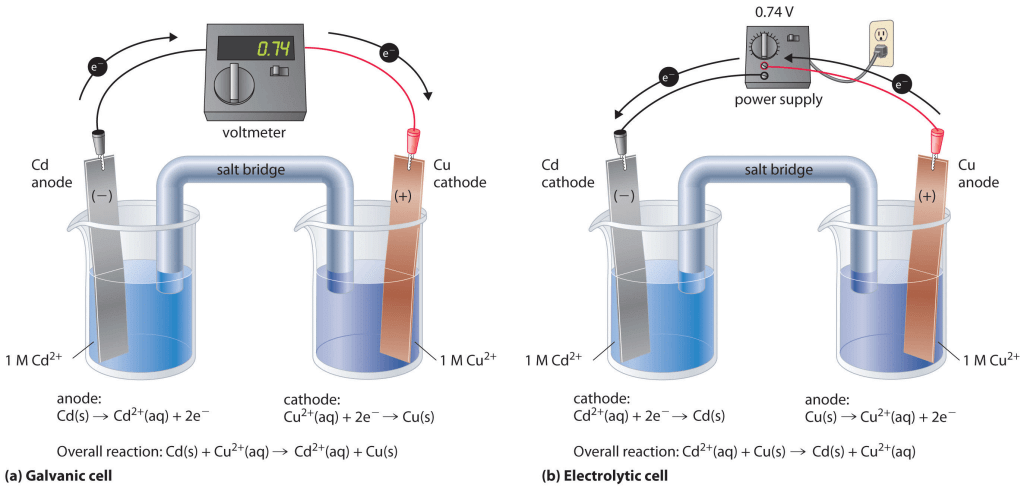
Reversible and irreversible cells
The Daniell cell has a standard emf of approximately 1.10 V. If an external emf equal in magnitude and opposite in direction to the cell emf is applied, the cell reaction stops. If the applied opposing emf is made slightly greater than the cell emf, the cell reaction reverses. A cell that meets the following conditions is termed reversible:
- The chemical reaction of the cell stops when an exactly equal opposing emf is applied.
- The chemical reaction of the cell is reversed (current reverses direction) when the opposing emf is made slightly greater than the cell emf.
Any cell that does not satisfy these two conditions is called irreversible. Examples of irreversible behaviour include cells in which side reactions occur or where electrode processes are not exactly the reverse on changing current direction. For example, a cell constructed as Zn | H2SO4 | Ag is irreversible because, when an external emf larger than the cell emf is applied, the expected reverse of the cell reaction does not occur; instead other reactions (such as oxidation of silver) take place.
- Cell reaction: Zn + 2H+ → Zn2+ + H2
- Under reverse driving, a competing reaction may occur: 2Ag + 2H+ → 2Ag+ + H2
Galvanic Cells
A galvanic cell (also called a voltaic cell) is an electrochemical device that generates electrical energy from a spontaneous redox reaction. It provides a clear example of conversion of chemical energy into electrical energy and is the basis of many primary (non-rechargeable) and secondary (rechargeable) batteries.
Working of Galvanic Cells
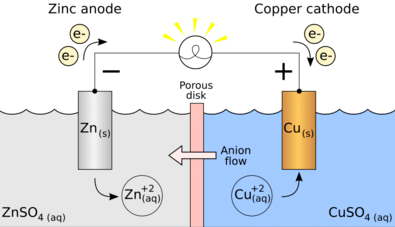
Working of Galvanic Cells
In a galvanic cell, oxidation and reduction are spatially separated in two half-cells. Electrons produced at the anode by oxidation travel through an external conducting wire to the cathode. The transfer of electrons from anode to cathode constitutes the electric current usable to do external work. The internal circuit is completed by ionic conduction through the electrolyte and a salt bridge which allows migration of ions so that electrical neutrality of each compartment is maintained.
The essential principle is separation of the two half-reactions, allowing controlled transfer of electrons through an external circuit rather than direct chemical contact between reactants.
Setup of a Galvanic Cell
A typical galvanic cell requires the following components:
- Two electrodes made of different metals (or other conductive materials) that act as anode and cathode.
- Electrolyte solutions in which the electrodes are immersed; each electrode is in contact with an electrolyte that contains the relevant ions.
- A conducting external wire connecting the two electrodes to allow electron flow.
- A salt bridge (or porous membrane) to permit migration of ions and maintain charge neutrality while preventing direct mixing of the solutions.
The oxidation half-reaction occurs at the anode (negative in a galvanic cell) and the reduction half-reaction occurs at the cathode (positive in a galvanic cell).
Understanding the Galvanic Cell with an Example (Zn-Cu)
Consider a galvanic cell made from zinc and copper electrodes: the zinc electrode is placed in ZnSO4 solution and the copper electrode in CuSO4 solution. When connected by an external wire and a salt bridge:
- Zinc is oxidised at the anode: Zn(s) → Zn2+(aq) + 2e–. Zinc electrode mass decreases.
- Copper(II) ions are reduced at the cathode: Cu2+(aq) + 2e– → Cu(s). Copper electrode mass increases.
- The salt bridge allows counter ions to move so that each compartment remains electrically neutral even as metal ions are produced or consumed.
- Electric current flows through the external circuit from the zinc electrode toward the copper electrode (electron flow from anode to cathode).
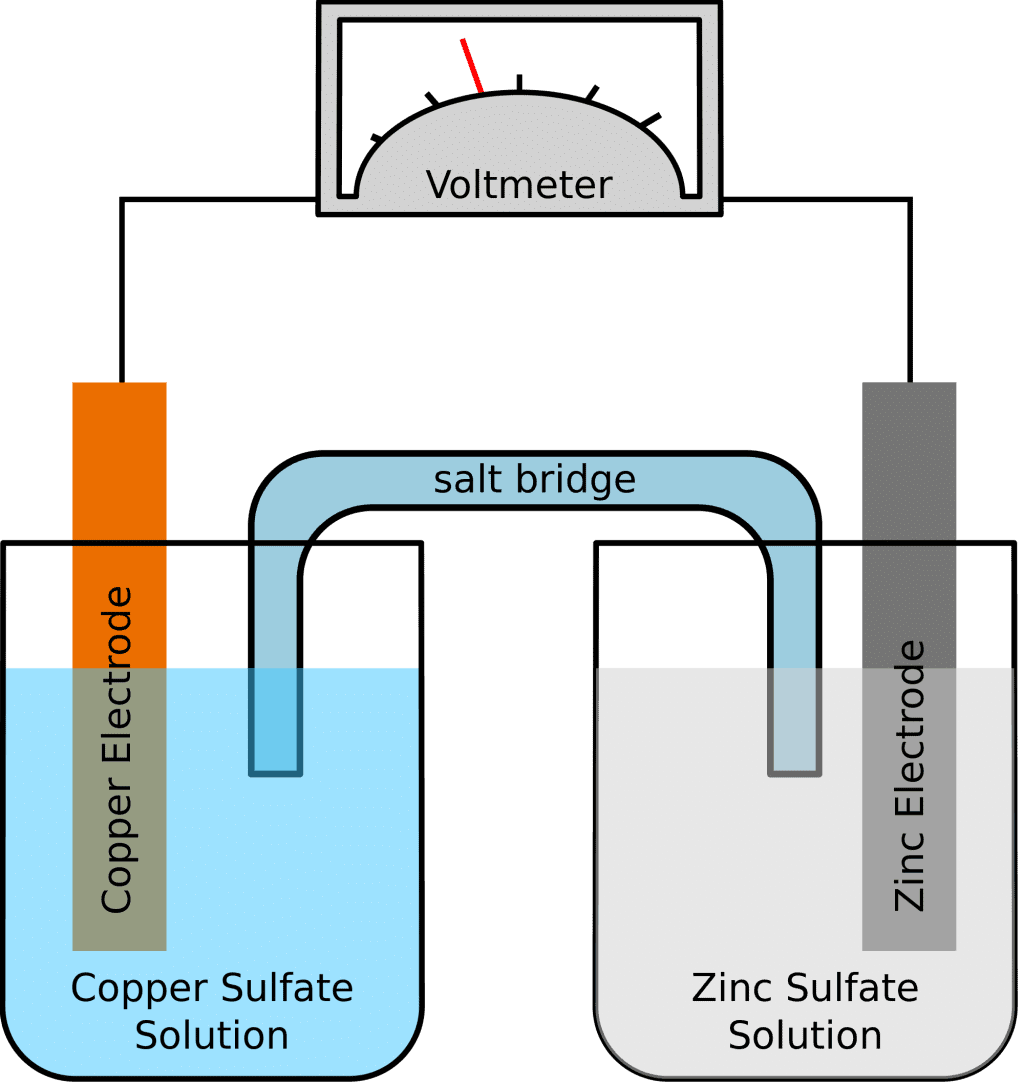
Galvanic cell
The salt bridge may contain an inert electrolyte such as KNO3 or KCl in a gel. Its purpose is to prevent charge build-up which would otherwise rapidly stop the cell current.
Some important terms
- Phase boundary: the interface between an electrode (metal) and its electrolyte; each electrode/electrolyte pair is a phase boundary where electron transfer occurs.
- Salt bridge: an ionic pathway (often a U-tube with concentrated inert electrolyte gel) that completes the internal circuit by allowing migration of ions and maintaining electrical neutrality of the half-cells.
- Oxidation and reduction: oxidation is loss of electrons; reduction is gain of electrons. Redox reactions are simultaneous-one species is oxidised and another reduced.
Solved Example
Q1. In a galvanic cell, what would happen if no salt bridge is used while the redox reaction takes place?
Ans: In the absence of a salt bridge, the redox reaction will begin in the normal way and electrons will flow through the external circuit initially. However, charge will quickly build up in the two compartments: the anode compartment becomes positively charged as cations accumulate and the cathode compartment becomes negatively charged as anions accumulate. This charge separation creates an internal electric field that opposes further electron flow. As a result, the cell current rapidly drops to zero and the reaction stops. Therefore, without a salt bridge the cell cannot sustain continuous current because it cannot maintain electrical neutrality in each compartment.
Summary
A Daniell cell is a classical example of a galvanic cell where spontaneous oxidation of zinc and reduction of copper(II) produce an emf of about 1.10 V. Galvanic cells convert chemical energy into electrical energy by separating oxidation and reduction into two half-cells, permitting controlled electron flow through an external circuit and ionic balancing via a salt bridge. Understanding half-reactions, electrode signs, and the role of the salt bridge is essential for analysing and constructing galvanic cells.
Want to save your progress? Log in to your account.