
Note · 5 Pages
Chapter Notes: Orienting Yourself: The Use of Coordinates
1.Introduction
A system of coordinates is a structured framework – like the grid lines on a map or graph paper – that enables us to use numbers to describe the exact physical locations of points or objects.
Historical Roots in Bhārat: The first systematic use of grids occurred in the Sindhu-Sarasvatī Civilisation, where city streets were built with striking precision in North-South and East-West directions at uniform distances of about 10 metres apart – a coordinate system in practice. Baudhāyana (c. 800 CE) later used East-West and North-South lines for deep geometric constructions, developing the Baudhāyana-Pythagoras Theorem, laying the foundation of coordinate geometry.
Ujjayinī was described – at least as early as the 4th century BCE – as the point marking the central longitude meridian from which all other locations were measured. Āryabhaṭa (c. 499 CE) replaced Greek ‘chords’ with ‘sines’, making it much easier to calculate the coordinates of stars and cities. Brahmagupta (c. 628 CE) formalised zero and negative numbers as algebraic entities, making the four-quadrant Cartesian plane possible.
René Descartes (1637 CE) formalised the fact that any point in a two-dimensional plane can be defined by just two numbers – representing the point’s distances from two perpendicular axes.
2. The 2-D Cartesian Coordinate System
The two-dimensional coordinate system uses two lines at right angles to each other to mark points in 2-D space. These are called the coordinate axes.
x-axis: The horizontal line.
y-axis: The vertical line.
Origin (O): The point of intersection of the x-axis and y-axis. Its coordinates are .
Cartesian / Coordinate / xy-plane: The plane in which the axes are situated.
Distances are marked off in equal units on both axes:
- Distances to the right of O or upward from O are positive.
- Distances to the left of O or downward from O are negative.
 Key Concept
The coordinates of a point P are written as , where:
• = perpendicular distance of P from the y-axis, measured along the x-axis (the x-coordinate or abscissa).
• = perpendicular distance of P from the x-axis, measured along the y-axis (the y-coordinate or ordinate).
Special cases:
- A point on the x-axis has coordinates of the form .
- A point on the y-axis has coordinates of the form .
- The origin O has coordinates .
- The x-coordinate of any point on the y-axis is 0.
- The y-coordinate of any point on the x-axis is 0.

Example: Point P is on the x-axis and is at a distance of 3 units from the y-axis to its left. Write the coordinates of point P.
Sol: Point P is at a distance of 3 units towards left, from y-axis.
Coordinates of point P are (-3, 0).
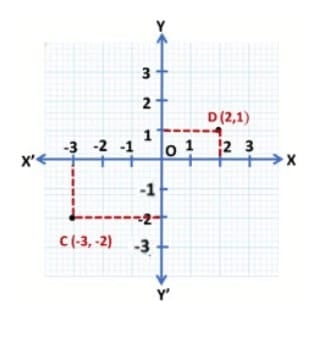
Example : Find distances of points C (-3, -2) and D (2, 1) from x-axis and y-axis.
Sol: C (-3, -2)
Distance from x – axis = 2 units
Distance from y – axis = 3 unitsD (2, 1)
Distance from x – axis = 1 units
Distance from y-axis = 2 unit
Important Rule
If , then . If , then .
3. Quadrants
The coordinate axes divide the Cartesian plane into four parts called quadrants, numbered I to IV (anti-clockwise from the top-right).
| Quadrant | x-coordinate | y-coordinate | Sign form |
|---|---|---|---|
| I | Positive (+) | Positive (+) | (+, +) |
| II | Negative (-) | Positive (+) | (-, +) |
| III | Negative (-) | Negative (-) | (-, -) |
| IV | Positive (+) | Negative (-) | (+, -) |
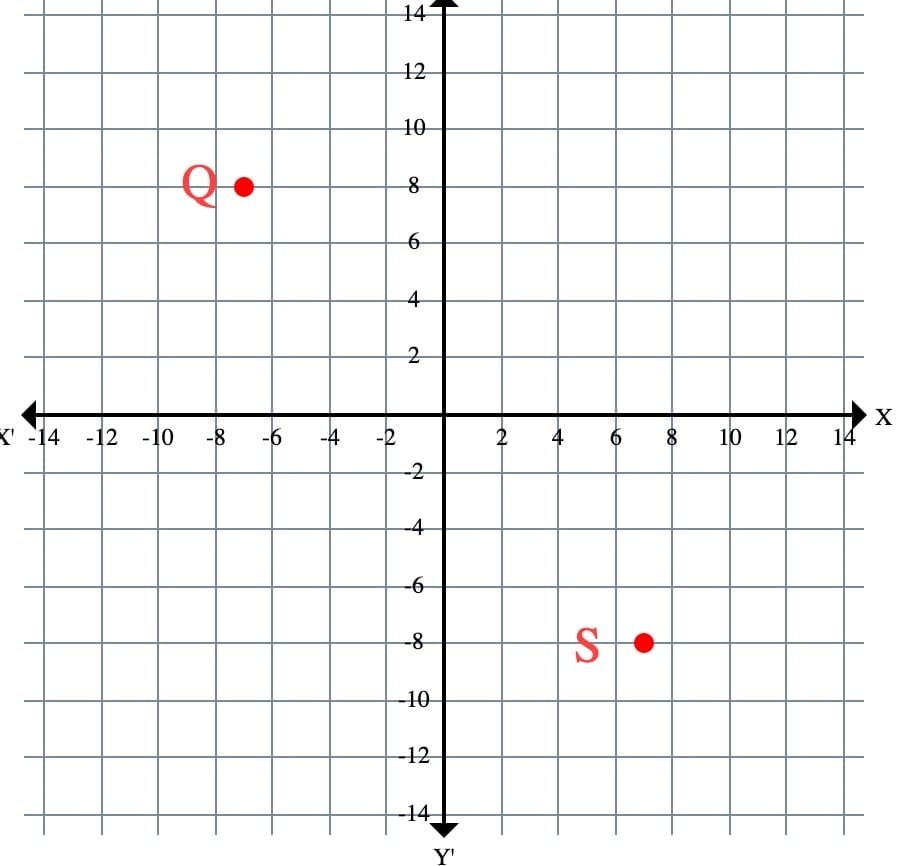
Example: Plot Point S(7, -8) and Point Q(-7, 8)
Example : Write the quadrant in which each of the following points lie:
(i) (-2, -4)
(ii) (1, -4)
(iii) (-3, 2)Sol: (i) (-2, -4)
Here, x coordinate = -2 and y coordinate = -4
As x coordinate and y coordinate both are negative (x < 0, y < 0) ,the given point lies in III quadrant.(ii) (1, -4)
Here, x coordinate = 1 and y coordinate = -4
As x coordinate is positive and y coordinate is negative (x > 0, y < 0 ) the given point lies in IV quadrant.(iii) (-3, 2)
Here, x coordinate = -3 and y coordinate = 2
As x coordinate is negative and y coordinate is positive (x < 0, y < 0 ) the given point lies in II quadrant.
4. Distance Between Two Points in the 2-D Plane
To find the distance between two points not lying on the same axis or a line parallel to an axis, we use the Baudhāyana-Pythagoras Theorem.
Consider moving from point to point :
- Distance along x-axis:
- Distance along y-axis:
By the Baudhāyana-Pythagoras Theorem:
Distance Formula:
Note
It makes no difference whether and are positive or negative, since we square both differences. Reflection in an axis preserves the lengths of all sides of a figure.
Example: Find the distance between points A(2, 3) and B(5, 7)
Example: Triangle PQR has coordinates:P (2, 5), Q (6, 3), R (4, 1) and Triangle P′Q′R′has coordinates:P′ (-2, 5), Q′ (-6, 3), R′ (-4, 1). Plot and verify It makes no difference whether and are positive or negative, since we square both differences. Reflection in an axis preserves the lengths of all sides of a figure.
Special cases:
- Distance between and (same y):
- Distance between and (same x):
Chapter Summary
- To locate a point in a plane, we require two perpendicular lines – one horizontal (x-axis) and one vertical (y-axis).
- The plane is called the Cartesian plane, the coordinate plane, or the xy-plane.
- The point of intersection of the axes is the origin O with coordinates .
- The coordinate axes divide the plane into four parts called quadrants.
- The distance of a point from the y-axis is its x-coordinate; from the x-axis is its y-coordinate.
- Points on x-axis: . Points on y-axis: .
- Quadrant signs: I(+,+), II(-,+), III(-,-), IV(+,-).
- If then ; if then .
- Distance between and : .
Want to save your progress? Log in to your account.