
Note · 10 Pages
Electrochemical Cells, Galvanic Cells & Measurement of Electrode Potential
Electrochemical Cells
An electrochemical cell consists of two electrodes, which are metallic conductors, in contact with an electrolyte, which is an ionic conductor. An electrode and the electrolyte in contact with it together form an electrode compartment.
Electrochemical cells are classified into the following types:
- Electrolytic cells: These cells use an external source of electrical energy to drive a non-spontaneous chemical reaction.
- Galvanic cells: These cells produce electrical energy as a result of a spontaneous redox reaction. They are also called voltaic cells.
Note: Oxidation always takes place at the anode and reduction always takes place at the cathode. However, the polarity of the electrodes depends on the type of cell:
- In a galvanic cell, the anode is negative and the cathode is positive.
- In an electrolytic cell, the anode is made positive with respect to the cathode by the external source.
Galvanic Cell
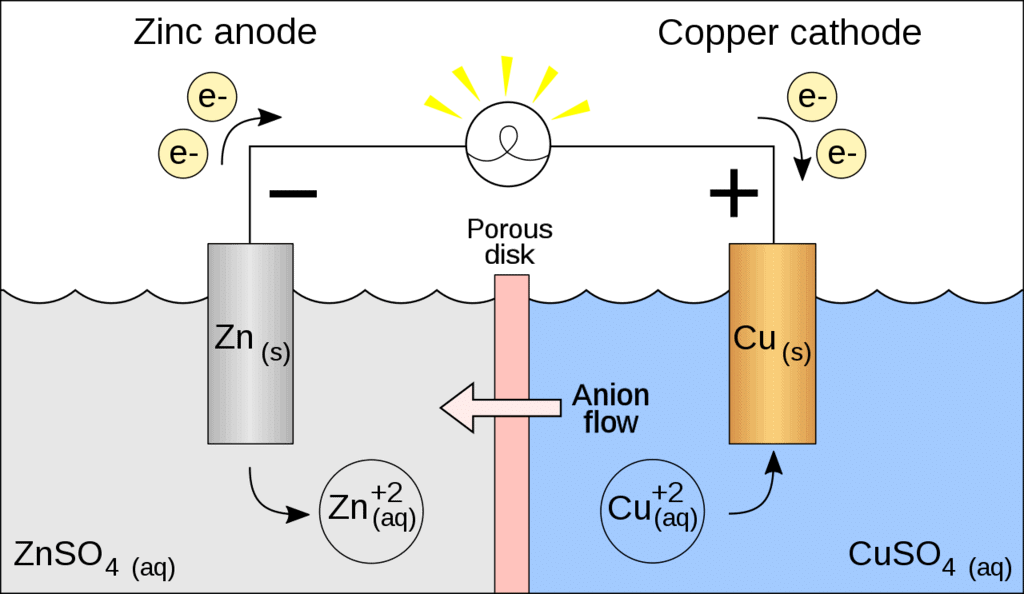
A galvanic cell converts chemical energy into electrical energy. It consists of two half-cells, namely an anodic half-cell and a cathodic half-cell. The cell reaction is a redox reaction.
 Galvanic Cell
In a Daniell cell, a zinc rod is immersed in a solution of zinc sulphate and a copper rod is immersed in a solution of copper sulphate. The zinc electrode acts as the anode, whereas the copper electrode acts as the cathode.
Electrode reactions in a Daniell cell
Oxidation at the anode:
Zinc loses electrons and is therefore oxidised.
Reduction at the cathode:
Copper ions gain electrons and are therefore reduced.
Overall cell reaction:
Electrons flow from the zinc anode to the copper cathode through the external circuit. Zinc dissolves to form zinc ions, while copper ions accept electrons and are deposited as copper at the cathode.
Representation of a Cell: IUPAC Conventions
The Daniell cell may be represented using the following cell notation:
The conventions used in cell representation are as follows:
- The anodic half-cell is written on the left and the cathodic half-cell is written on the right.
- The two half-cells are separated by double vertical lines. These lines represent a salt bridge or another porous partition.
- A single vertical line represents a phase boundary between an electrode and the electrolyte solution.
- The cell emf may be written on the right-hand side of the cell notation.
- An inert electrode is used when a suitable solid conducting electrode is not present in the redox couple. Common inert electrodes include platinum and graphite.
The Daniell cell can also be written in ionic form as:
Zn|Zn2+ ||Cu2+ |Cu
An example involving an inert platinum electrode is:
Electrochemical Cell and Gibbs Energy of the Reaction
If a charge passes through a potential difference , the electrical work obtained is . For a galvanic cell operating reversibly, the maximum electrical work is equal to the decrease in Gibbs energy of the reaction.
For a reaction involving the transfer of moles of electrons, the charge passed is , where is the Faraday constant. Therefore, for a cell emf :
Here, is an intensive quantity, whereas is an extensive thermodynamic quantity. Consequently, the value of depends on the stoichiometric form of the reaction, while the cell potential does not change when the complete reaction is multiplied by a factor.
For the Daniell cell reaction:
Two electrons are transferred, so:
If the reaction is doubled:
Four electrons are transferred and therefore:
Thus, the cell potential remains unchanged, but the Gibbs energy change is doubled.
Under standard conditions, the relation becomes:
When the concentration or activity of every reacting species is unity, the cell potential is the standard cell potential, . Thus, measurement of gives the standard Gibbs energy change of the reaction.
The standard Gibbs energy change is related to the equilibrium constant by:
Combining the two relations gives:
Relationship Between Gibbs Energy and Electrode Potential
The electrical work obtained from a cell is:
Since the maximum useful work obtained reversibly from a cell is equal to the decrease in Gibbs energy:
Under standard conditions:
For a spontaneous process, is negative. Therefore, is positive when the cell reaction proceeds spontaneously in the written direction.
If is positive, is negative and the reaction is non-spontaneous in the written direction. At equilibrium, both and are zero.
| Reaction | ΔrG | Ecell |
| Spontaneous | Negative | Positive |
| Non-spontaneous | Positive | Negative |
| Equilibrium | Zero | Zero |
The standard Gibbs energy change of a cell reaction can therefore be calculated from standard electrode potential data.
Measurement of Electrode Potential
Electrode Potential
When a metal is dipped into a solution containing its ions, a potential difference develops at the metal-solution interface. This potential difference is called the electrode potential.
A single electrode potential cannot be measured directly. It is measured by connecting the electrode to a reference electrode and measuring the emf of the resulting electrochemical cell under open-circuit conditions.
The standard hydrogen electrode is used as the primary reference electrode. It consists of platinum in contact with hydrogen gas at standard pressure and hydrogen ions with unit activity. Its standard reduction potential is assigned the value:
Electrode potentials are generally tabulated as standard reduction potentials. A more positive reduction potential indicates a greater tendency of the species to undergo reduction under standard conditions.
Electromotive Force of a Cell
Electrons flow from the anode to the cathode through the external circuit because of the potential difference between the two electrodes. This driving potential difference is called the electromotive force, or emf, of the cell. Its SI unit is the volt.
For a galvanic cell operating under any specified conditions:
Under standard conditions:
\[E^\circ_\mathrm{cell}=E^\circ_\mathrm{cathode}^{\mathrm{red}}-E^\circ_\mathrm{anode}^{\mathrm{red}}\]
For the Daniell cell, the standard reduction potentials are approximately:
Therefore:
Sign Convention of EMF
The emf of a cell should be positive for a reaction to be feasible and spontaneous in the direction in which the cell is written.
For the Daniell cell:
This representation describes a feasible spontaneous reaction.
If the cell is written in the reverse direction:
The reverse reaction is not spontaneous under the same conditions. It would require an external source of electrical energy.
Electrode Potential Under Non-standard Conditions
For a general cell reaction, the cell potential under non-standard conditions is related to the reaction quotient by the Nernst equation:
At , this is commonly written as:
The reaction quotient includes the activities or concentrations of the reacting species. Pure solids and pure liquids are not included in .
Salt Bridge
The two electrolyte solutions in a galvanic cell are connected by a salt bridge. A salt bridge is generally a U-shaped tube containing a concentrated solution of an inert electrolyte in agar-agar gel.
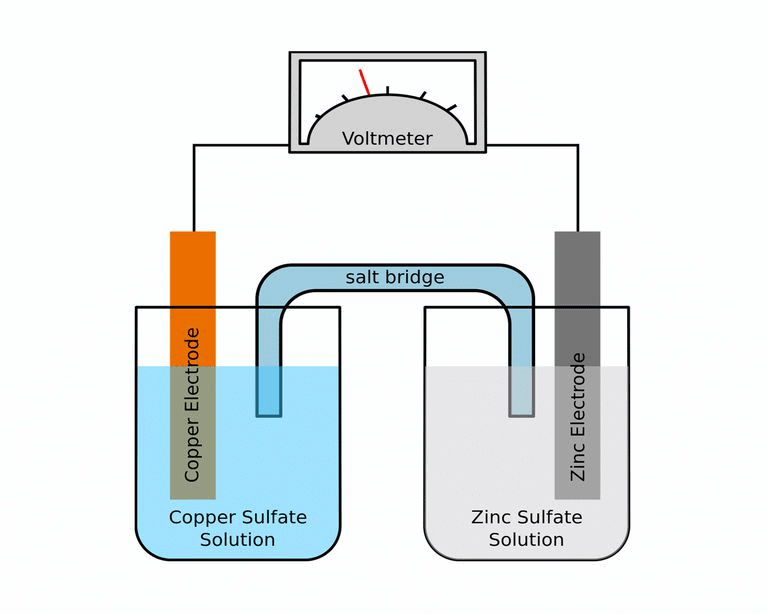 Fig: Salt bridge
Common electrolytes used in salt bridges include , , and . The electrolyte should not react with the ions present in either half-cell.
The salt bridge performs the following functions:
- It completes the electrical circuit by allowing ionic conduction between the two half-cells.
- It maintains electrical neutrality in both half-cells.
- It minimises or eliminates the liquid junction potential.
- It prevents the direct mixing of the two electrolyte solutions.
- It permits the migration of ions while keeping the two half-cells electrically connected.
The salt bridge contains a high concentration of ions such as and . The cation and anion are selected to have nearly similar ionic mobilities so that the liquid junction potential is minimised.
In a Daniell cell, anions from the salt bridge migrate towards the zinc half-cell, where positive zinc ions are produced. Cations migrate towards the copper half-cell, where copper ions are consumed. This ion migration maintains charge balance and allows the cell reaction to continue.
Want to save your progress? Log in to your account.